Teaching
In every course, I hope students leave not only knowing the material but with a way of thinking they can keep using after the course ends.
Undergraduate
Fall 2015 – Spring 2026
16 semesters
Next: Spring 2027
Introductory Sociology for Healthcare Professions
Is it a personal trouble, or a public issue?
The course is built around five questions sociologists keep asking: Is it a personal trouble or a public issue? Who gets to define it? Who gains and who loses? What holds people together? How are people shaped, and how do they act? Each class works through one case, often from health and medicine, and students learn to look at the same case through different theoretical lenses.
Sent by my students (11)
Videos and articles students sent me because they connected them to something we discussed in class. The list began in 2015, when Tiffany Kwan suggested I keep a place on my website where these could accumulate over the years.
- HealthOn sports-betting addiction
- HealthU.S. life expectancy creeps up as Covid deaths fall
- HealthThe doctor-nurse game
- GenderMen named John outnumber all women in most American industries
- ClassTime millionaires: meet the people pursuing the pleasure of leisure
- ClassLearning from dirty jobs
- RaceWhites swim in racial preference
- GenderWorried about your teenage daughter? Move to the Netherlands
- GenderFifty shades of gay
- GenderFamous quotes, the way a woman would have to say them during a meeting
- ImmigrationThe two Asian Americas
New in Spring 2027
A Self of One’s Own: Work and Meaning from Weber to Brave New World to AI
How much of who you are comes from the work you do?
The self is not simply found within us; it is shaped by markets, organizations, families, and ideas about a worthy life. We trace the call to “find yourself” in work, from Weber’s calling to “follow your passion,” Huxley’s Brave New World, and the question AI forces on us.
Undergraduate and graduate
Medical Sociology
What can we learn about health and illness that biology alone cannot tell us?
Faced with the same symptoms, why does one person see a doctor while another does not? What happens once they get there? And how does a behavior once seen as bad come to be treated as an illness? Students study who gets sick, how people live with illness, how patients, doctors, and nurses deal with one another, and how the reach of medicine grows and shrinks. Syllabus (Spring 2017)
Graduate
4 semesters
Multivariate Statistics
What can a regression line tell us, and when does it mislead?
Much of the quantitative research students will read builds on linear regression. They learn it from the ground up—how ordinary least squares works, what it assumes, and how to check those assumptions in real data—then move on to linear probability and quantile models, missing data, survey weights, mediation, and a first look at panel data. Syllabus (Fall 2024)
10 semesters
Regression Models for Categorical Data
What if the outcome is yes or no, one of several choices, or a count?
Did someone vote? Which party did they choose? How many times did they see a doctor last year? Many outcomes sociologists care about are not continuous, and ordinary regression handles them poorly. Students work through binary, multinomial, and ordered logit and probit, count models, and an introduction to survival analysis, ending with mediation. Syllabus (Spring 2024)
Longitudinal Data Analysis
What do we learn by following the same cases over time?
Following the same people—or households, organizations, or countries—over time lets us ask how things change, not only how groups differ. Students learn fixed-effects and mixed-effects models, duration models, sequence analysis, and time series, reading each method alongside a published study that uses it. Syllabus (Fall 2025)
Event History Analysis and Sequence Analysis
Will it happen, when, and in what order?
Wars, births, deaths, strikes, job promotions: event history analysis asks whether and when something happens. Students move from nonparametric methods such as life tables and Kaplan–Meier curves, to parametric and semiparametric (Cox) models, to discrete-time models and competing risks. Sequence analysis then follows the whole path: the order and timing of jobs, partnerships, and children across a life. Syllabus (Spring 2019)
In students’ words
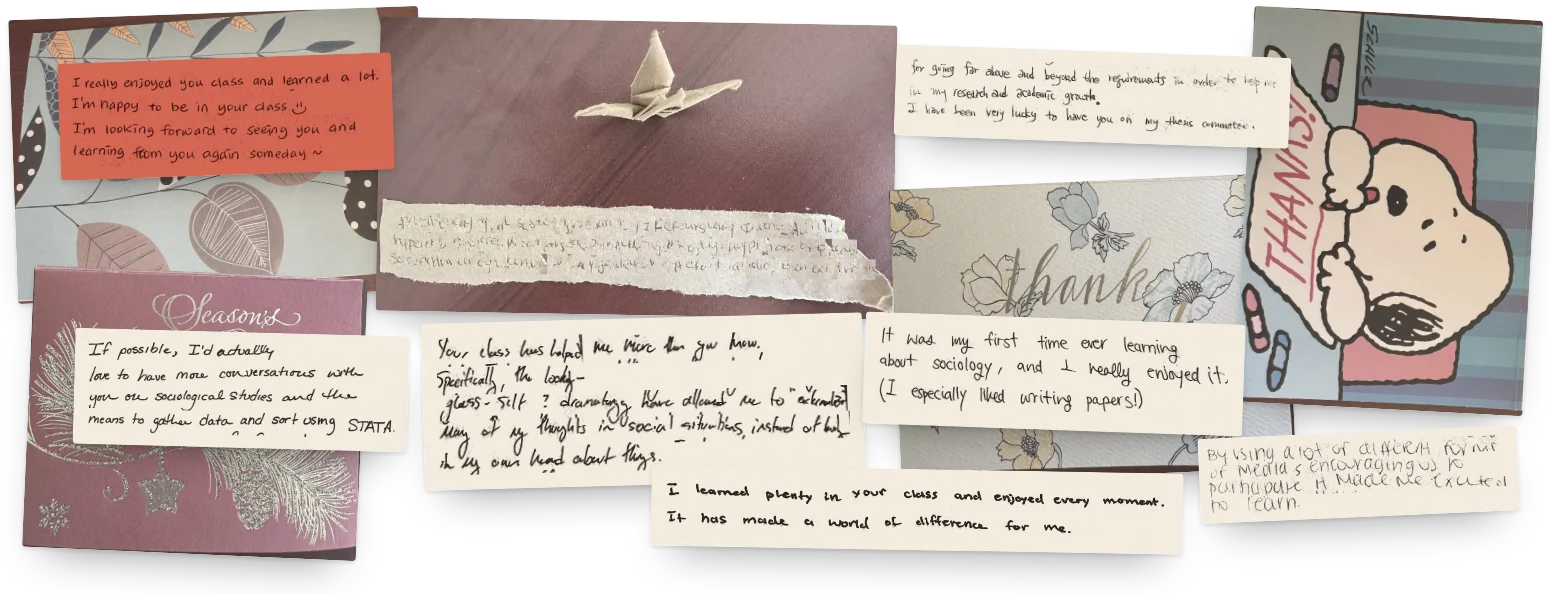
“This course has made me a better thinker, a better citizen, a better person, and a better future healthcare provider. … Everybody who is going to work as a healthcare provider should take this course to better understand what their patients might be going through.”
“As a pre-medical student, I’ve always been competing for the best scores and focused on getting an A in a class. Being in your course was the first time I felt like I was encouraged to learn.”
“Covered advanced material without being overwhelming. … Gave a lot of really helpful, practical information that we can use immediately in our work.”
“My understanding of statistics has grown a lot and I have already seen the effects of this in my work and research.”
Teaching record
Semesters at Boston College, Fall 2015 to Spring 2027.